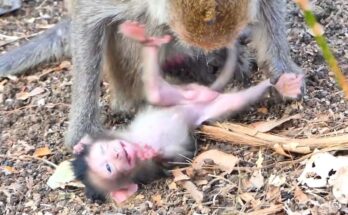
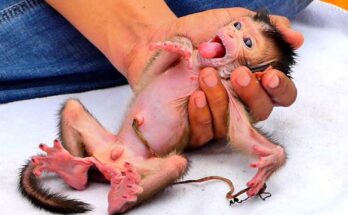
Real life daily monkeys live within strong family structures where learning, bonding, and survival happen together every single day. From early morning to nightfall, monkeys groom one another, search for food, rest in safe places, and protect their young. For babies especially, daily life is centered on the mother. Her body is the baby’s shelter, transportation, and classroom. How a mother carries her baby, feeds it, and responds to its signals shapes the baby’s physical and emotional development.
Young monkey mothers are still learning themselves. Even though instinct guides them, experience plays a big role in confident parenting. A young mom may carry her baby upside down at times, especially while climbing or moving quickly. In the wild, this position can be normal for short moments, as babies are born with strong gripping reflexes. They cling tightly to their mother’s fur, using their hands, feet, and tail to stay secure. This upside down carrying allows the mother to move freely while keeping her baby close.
However, balance is important. While short periods upside down are natural, babies still need frequent contact with the mother’s chest, where they feel warmth, hear her heartbeat, and nurse easily. This close position helps regulate the baby’s breathing and emotions. A young mother must learn when her baby needs comfort versus movement. Observing older mothers in the group helps her improve her skills day by day.
The question many people ask is whether a baby will like being carried this way, like Sweetpea once was. Baby monkeys do not think in terms of liking or disliking in a human sense. They respond to safety. If they feel secure, supported, and close to their mother, they remain calm. If they feel unstable, hungry, or frightened, they cry, cling harder, or show signs of stress. Sweetpea’s reactions showed how deeply babies depend on correct care and familiar comfort.
In daily monkey life, babies adapt to their mother’s movements. They learn how to shift their grip, adjust their bodies, and trust their mother’s strength. This learning is part of growing up. But when a baby experiences fear, separation, or inconsistent care, that trust can be shaken. Stress in early life affects how confident and relaxed a monkey becomes later. That is why gentle handling and stable routines are so important.
Groups like SP BBlover often observe these details because they reveal the emotional world of monkeys. Watching a young mom carry her baby upside down can be a sign of normal learning, but it also reminds us how vulnerable babies are. One slip, one moment of panic, or too much strain can cause harm. In nature, other monkeys stay nearby, offering protection and support. Community plays a big role in raising healthy young monkeys.
Sweetpea’s story raised awareness about how sensitive baby monkeys are. Babies remember comfort and distress through their bodies. If a baby associates being carried with safety, warmth, and milk, it grows calmer and stronger. If it associates carrying with fear or discomfort, it may cry more, cling anxiously, or struggle to relax. These behaviors are not weakness, they are survival responses.
Real life daily monkeys show us that parenting is not perfect, even in nature. Young mothers learn, babies adapt, and groups support one another. What matters most is allowing these natural processes to happen without harmful interference. Babies belong with their mothers, learning through closeness and trust. Whether carried upright or briefly upside down, a baby’s needs must always come first.
Understanding these daily moments helps humans develop respect for monkey families. They are not entertainment or experiments, but living beings navigating life one day at a time. When we observe with empathy, we see that every carry, every cry, and every quiet moment of clinging is part of a delicate journey toward survival and independence.