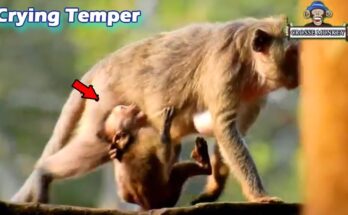
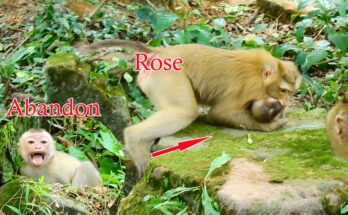
Monkeys live highly emotional and socially connected daily lives, where relationships and feelings influence behavior as much as instinct does. From morning to night, their routines are shaped not only by food, safety, and movement, but also by reassurance, attachment, and learning. One situation that often surprises people is when a small monkey cries and screams loudly even while staying close to its mother. To human eyes this may seem confusing, but in the monkey world it is a very real and meaningful part of development.
A typical day for monkeys begins at dawn. The troop wakes together in trees or other safe sleeping places, still close from the night. Mothers immediately check on their babies, adjusting their grip, grooming them gently, and offering warmth. For most infants, this closeness provides comfort and security. However, for a small monkey like Sweetpea, emotions can still overflow despite being with mom.
Baby monkeys are born extremely dependent. Their brains and nervous systems are still developing, which means they experience emotions very strongly but cannot regulate them well. Crying and screaming are their main ways of communicating. When Sweetpea cries loudly, it does not always mean danger or neglect. Often, it means confusion, frustration, fear, hunger, or a need for reassurance that words cannot express.
Throughout the morning, the troop begins to move to feeding areas. Mothers carry their babies while walking, climbing, and jumping. This movement can be exciting but also frightening for a small monkey. Even while clinging tightly to mom, Sweetpea may cry because the world feels overwhelming. New sounds, sudden movements, or unfamiliar troop members can trigger fear responses.
Crying is also a way for baby monkeys to demand attention. Even though the mother is present, Sweetpea may want more than physical closeness. He may want milk, grooming, eye contact, or simply reassurance that nothing bad will happen. Baby monkeys do not yet understand patience. If their needs are not met immediately, crying becomes louder and more urgent.
Social pressure can also cause distress. Monkey troops are busy environments with many individuals interacting at once. Dominant monkeys move confidently, juveniles play roughly, and conflicts can happen suddenly. A baby like Sweetpea may sense tension even if nothing directly involves him. His screaming can be a response to emotional stress picked up from the group.
Sometimes, crying occurs during important learning stages. As baby monkeys grow, mothers gradually encourage independence. This may include limiting nursing time, allowing brief separation, or discouraging constant clinging. Even if the mother is nearby, these small changes can feel terrifying to the baby. Sweetpea’s crying may be a protest against growing up, not a sign of abandonment.
Milk plays a major role in emotional comfort. Nursing is not only nutrition but also security. If Sweetpea wants milk and does not receive it right away, he may scream loudly even while sitting with his mother. From the baby’s perspective, the refusal feels confusing and upsetting. He does not understand long-term needs, only immediate desire.
Mothers often remain calm during these episodes. Experienced mother monkeys understand that crying does not always signal real danger. They continue grooming, moving, or feeding while allowing the baby to express emotion. This teaches the infant that feelings can pass without panic. Over time, babies learn emotional regulation through these repeated experiences.
Midday usually brings a quieter period. Monkeys rest in shaded areas, grooming one another and conserving energy. For many babies, this is when crying slows and sleep takes over. However, a sensitive baby like Sweetpea may still cry before settling down. The crying can be a release of built-up tension from the morning’s stimulation.
Even while resting, babies stay alert. A sudden sound, movement, or unfamiliar face can restart crying instantly. The presence of the mother does not eliminate fear completely; it only makes fear manageable. Sweetpea’s screaming shows that emotional security is a process, not a switch.
As afternoon arrives, activity increases again. Young monkeys play, chase, and climb. Babies observe closely, sometimes wanting to join but lacking confidence. Sweetpea may cry because he wants to play but feels too small, or because he wants to stay close to mom but is curious about others. This emotional conflict often results in loud vocalization.
Crying also serves a social purpose. It signals to the troop that the baby is vulnerable. This often prevents aggression from others and encourages gentle behavior nearby. Even though Sweetpea is with his mother, his crying reinforces his protected status within the group.
As evening approaches, monkeys regroup and grooming becomes more frequent. Mothers groom babies carefully, helping them calm down. Sweetpea’s crying may soften into quiet sounds as he relaxes. Physical touch, warmth, and rhythm play a huge role in emotional regulation at this stage of life.
Nighttime is when emotions can surface again. Darkness, unfamiliar noises, and fatigue make babies more sensitive. Even while sleeping close to mom, Sweetpea may wake and cry briefly, checking that safety is still there. These small cries are normal and usually short-lived.
The daily lives of monkeys show that crying is not a failure of care, but a natural part of development. Babies cry because they are learning how to exist in a complex social world. Being with mom provides safety, but it does not erase fear, curiosity, frustration, or growing independence.
Sweetpea’s loud crying and screaming, even while staying with his mother, reflect a young mind processing too much information at once. Each day, through repeated comfort and gentle limits, he learns that emotions pass and safety remains. Over time, crying decreases as confidence grows.
In the end, real-life daily monkeys remind us that emotional growth takes time. A baby monkey crying in its mother’s arms is not broken or unhappy; it is learning. Through daily routines of movement, feeding, rest, and reassurance, babies like Sweetpea slowly become calmer, stronger, and more independent. Their cries are the sound of growth in progress, echoing the deep emotional life that defines monkey society.