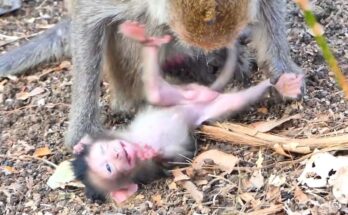
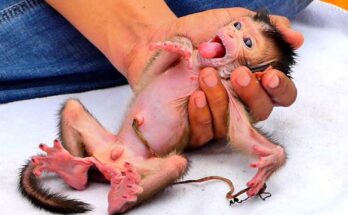
A new life begins quietly yet dramatically in the wild, and the first moments of a baby monkey’s life are filled with vulnerability, instinct, and profound meaning. In real-life daily monkeys, birth is not celebrated with ceremony, but it marks one of the most critical transitions in the natural world. From the instant a baby monkey enters the world, survival becomes the central challenge. The newborn arrives with closed or half-open eyes, a fragile body, and an instinctive need to cling. Its tiny fingers grasp its mother’s fur almost immediately, a reflex that may determine whether it lives or dies. These first moments reveal how deeply life in the wild depends on instinct, connection, and constant awareness.
The mother monkey plays the most vital role in these early moments. She cleans the newborn, removes the birth membranes, and brings the baby close to her chest for warmth. This contact is essential, as newborn monkeys cannot regulate their body temperature well. The mother’s body heat protects the infant from cold, rain, and wind, while her alert posture shields it from danger. In daily monkey life, predators, falls, and social threats are always present, and the first hours after birth are among the most dangerous. A mother must balance exhaustion with vigilance, staying alert even while recovering from labor.
The newborn’s first attempts to nurse usually happen quickly. Milk is life. It provides not only nutrition but also antibodies that protect against disease. Suckling also strengthens the bond between mother and baby, calming both through hormonal responses. In the wild, if a baby fails to latch properly or the mother is inexperienced, the infant’s survival is at risk. Older, experienced mothers often show remarkable patience, guiding the baby gently, while younger mothers may struggle, learning through instinct and trial. These moments of learning are part of the daily reality of monkey life, where mistakes can be costly but adaptation is constant.
Around them, the troop reacts subtly to the new life. Other monkeys may watch from a distance, curious but cautious. Some females approach to inspect the baby, while others keep their distance to avoid conflict. In many monkey societies, newborns attract attention, and the mother must protect her infant from overly curious or dominant individuals. Social hierarchy plays a significant role even in these first moments. The baby is born into an existing social structure, and its future status may be influenced by its mother’s rank, alliances, and experience.
As hours pass, the baby monkey begins to adjust to the rhythms of the wild. It clings tightly as the mother moves through trees or across the ground, learning balance and motion without conscious effort. The sounds of the forest—birds, insects, wind, and other monkeys—become the soundtrack of its earliest memories. Loud noises may startle the infant, causing it to tighten its grip or cry softly. These cries are not meaningless; they are communication, signaling discomfort, hunger, or fear. In daily monkey life, sound is a powerful tool for survival.
The environment shapes every aspect of the newborn’s experience. Sunlight filtering through leaves provides warmth, while rain can become a serious threat. A sudden storm may force the mother to seek shelter, hunching over her baby to protect it from the cold. In these moments, the fragility of new life is clear. A single slip, a broken branch, or an unexpected predator could end the story before it truly begins. Yet, despite these dangers, monkeys continue to give birth and raise young in such environments, a testament to their resilience and adaptability.
As days pass, the baby monkey grows stronger. Its grip improves, its eyes open wider, and its awareness of the world increases. Still, it remains completely dependent on its mother. She decides when to move, where to rest, and when to feed. The baby learns through constant contact, absorbing information about safety, food, and social behavior simply by being close. This learning without words is central to daily monkey life. Survival skills are not taught formally; they are lived and observed.
Other members of the troop gradually become part of the baby’s world. Older siblings may approach, attempting to touch or carry the infant under the watchful eye of the mother. These interactions help the baby become familiar with social contact beyond the mother, laying the foundation for future relationships. Grooming, play, and gentle exploration will come later, but even in these early days, social bonds begin to form. In monkey societies, no individual truly lives alone, and the baby’s identity develops within the group.
The emotional aspect of these first moments is often underestimated. Monkeys experience fear, comfort, curiosity, and stress in ways that closely resemble human emotions. A newborn separated briefly from its mother may panic, crying loudly until contact is restored. The relief when reunited is visible in its relaxed posture and quieted voice. These emotional responses are not weaknesses; they are survival mechanisms that ensure the baby remains close to protection. Daily monkey life is deeply emotional, even if it is driven by instinct.
As the baby monkey’s first days turn into weeks, its chances of survival increase, but danger never disappears. Illness, accidents, and social conflict remain constant threats. Still, the beginning matters. A strong start—successful nursing, attentive maternal care, and stable social surroundings—can make the difference between life and loss. Each surviving infant represents continuity, the passing of genes, knowledge, and social bonds from one generation to the next.
A new life beginning in the wild is not a gentle story, but it is a powerful one. The baby monkey’s first moments are shaped by instinct, care, and the unforgiving reality of nature. Yet within that harshness is tenderness: a mother’s constant touch, the warmth of her body, and the quiet determination to protect her young. In real-life daily monkeys, these moments happen every day, unseen by most, yet they are the foundation of the species’ survival. Each newborn clinging to its mother is a reminder of how life persists, adapts, and begins again, even in the most challenging environments.