Daily life among monkeys is shaped by routine, relationships, memory, and emotion. From early morning to dusk, monkey groups move through familiar territories, feeding, grooming, resting, and responding to one another’s calls. These activities form the visible structure of their days, but beneath them lies a rich emotional world. Monkeys are highly social animals, and their well-being depends on stable bonds, especially between mothers and infants. When those bonds are disrupted, the impact can be profound, even if it is not expressed in ways humans immediately recognize.
In the early stages of life, a baby monkey’s entire universe revolves around its mother. She provides milk, warmth, protection, and guidance. Her scent, touch, and voice become the baby’s anchors of safety. For a baby like Royston, Kunthea’s mom was not just a caregiver but the center of his emotional world. Every daily routine—feeding, resting, traveling—was tied to her presence. When that presence is suddenly missing, the baby’s sense of security collapses.
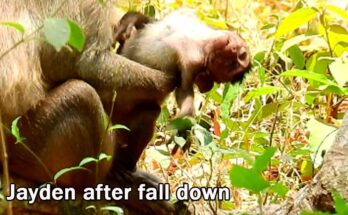
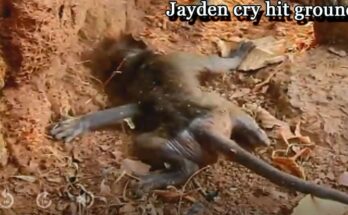
Grief in monkeys does not look exactly like human grief, but it is real and observable. Baby Royston’s complaints—his repeated cries, restless movements, and searching behavior—reflect distress and loss. Young monkeys vocalize when frightened or uncomfortable, but grief-related calls often have a different tone: more persistent, more desperate. These sounds are attempts to reconnect, to call back what has disappeared. In the daily life of monkeys, such vocalizations are meaningful signals that something is wrong.
When a mother disappears due to death, separation, or rejection, the group dynamic shifts. Other monkeys notice the baby’s distress. Some may approach cautiously, while others keep their distance. Adult females sometimes show interest, sniffing or grooming the orphaned infant. In rare cases, one may take on a caregiving role. More often, however, the baby is left in an uncertain state, relying on the tolerance of the group and whatever comfort it can find.
Royston’s grief unfolds within this uncertain space. Without Kunthea’s mom, familiar routines break down. Feeding times become irregular, resting spots feel unsafe, and the baby must constantly adjust to a world that no longer responds as before. His complaints are not just about hunger or fear; they reflect confusion. Monkeys thrive on predictability, and loss shatters that structure.
Daily monkey life does not pause for grief. While Royston mourns, the group continues to forage, groom, and move. This contrast can appear cruel to human observers, but it reflects the reality of survival-based societies. The group must continue functioning to protect itself from predators and starvation. Individual suffering is absorbed into the collective rhythm. Still, the baby’s distress subtly affects the group, increasing alertness and tension.
Social bonds among monkeys are reinforced through touch. Grooming, holding, and close contact regulate stress. When Royston lacks consistent physical comfort, his stress levels rise. He may cling to nearby adults or sit alone, rocking slightly or vocalizing softly. These behaviors resemble grief-related behaviors seen in other primates, including apes. They show that emotional pain is not exclusive to humans.
Memory plays a powerful role in monkey life. Babies recognize their mother’s face, voice, and smell. After loss, they often search familiar paths, pause where the mother once rested, or respond to similar calls from other females. Royston’s grief includes this searching behavior—an ongoing attempt to reconcile memory with reality. Over time, these searches may decrease, but the early days are marked by repeated disappointment.
The group’s response can shape the baby’s chances of survival. If tolerated, Royston may be allowed to remain close to others during feeding or resting. If rejected, he may be pushed aside, making survival difficult. Monkey societies are not uniformly compassionate, but they are flexible. Relationships can change, especially when infants are involved. Sometimes a baby’s persistence elicits care where none was initially offered.
Environmental conditions also influence outcomes. In resource-rich environments, groups may be more tolerant, increasing the likelihood that an orphaned baby survives. In harsh conditions, competition intensifies, and vulnerable individuals suffer more. Royston’s grief exists within this larger ecological context, shaped by food availability, group size, and external stressors.
Over time, if Royston survives, his behavior will gradually change. His complaints may become less frequent, replaced by cautious exploration and increased attention to social cues. This does not mean the loss is forgotten. Instead, it becomes integrated into his development. Studies of primates show that early loss can influence social behavior later in life, making individuals either more withdrawn or more socially attentive.
It is important to avoid projecting human narratives too strongly onto monkey behavior, yet it is equally important not to deny their emotional depth. Grief in monkeys is not symbolic or verbal, but it is embodied—in cries, posture, movement, and behavior. Royston’s expressions of distress are valid responses to a profound disruption in his world.
Daily life among monkeys teaches us that emotion and survival are intertwined. Bonds form because they enhance survival, but when they break, suffering follows. Kunthea’s mom’s absence leaves a void that cannot be easily filled. Royston’s grief is a reminder that monkey societies are not just collections of instincts, but living communities shaped by relationships and memory.
In conclusion, real-life daily monkeys experience loss in ways that are subtle yet deeply impactful. Baby Royston’s complaints and visible grief after losing Kunthea’s mom reflect the emotional cost of disrupted bonds. Within the ongoing rhythm of monkey life—feeding, moving, grooming—there is space for sorrow, confusion, and adaptation. By observing these moments with care and understanding, we gain a deeper appreciation of monkeys as emotional beings, navigating a world that is as challenging and fragile as our own.