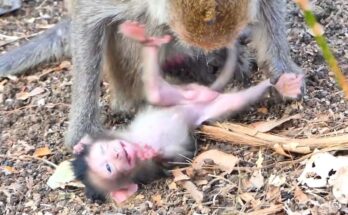
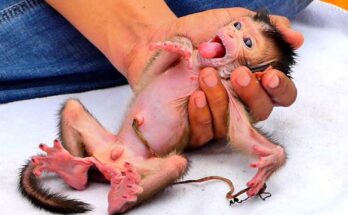
Real-life daily monkeys live within a natural world that is both nurturing and unforgiving, where every day brings routine responsibilities as well as unpredictable challenges. From sunrise to sunset, monkeys travel through trees and along forest edges, relying on social bonds, memory, and instinct to survive. Their lives are structured around feeding, grooming, caring for young, and staying alert to danger. While many moments appear calm or playful, others are difficult to witness, especially when they involve newborn infants who are entirely dependent on their mothers for survival.
The arrival of a newborn monkey is usually a quiet but important event within a troop. Newborns are born small, weak, and unable to care for themselves. They rely on immediate contact with their mother for warmth, milk, and protection. Most mothers respond instinctively, holding the infant close and adjusting their movements to keep the baby safe. This early bonding is critical in the first hours and days of life, as it determines whether the infant can begin to grow stronger.
However, nature does not always unfold in expected ways. In rare cases, a mother may not accept her newborn, even if the baby is returned to her after separation. This rejection can be confusing and distressing to human observers, but it is not driven by cruelty. Factors such as stress, inexperience, illness, or lack of resources can influence maternal behavior. In the wild, a mother must constantly balance her own survival with the demands of caring for an infant, and sometimes that balance fails.
High in the trees, where monkeys spend much of their time, the environment adds another layer of risk. Trees provide safety from ground predators and access to food, but they also require strength and coordination. A newborn that is not securely held is vulnerable to slipping or losing its grip. When a baby falls from a high place, it is a tragic reminder of how fragile life can be in an arboreal environment. Such events should be understood with sensitivity, without exaggeration or graphic focus, as they are part of the harsh realities of wildlife survival.
When a newborn is returned to its mother and still not accepted, the situation highlights the limits of intervention in nature. Even when intentions are compassionate, outcomes cannot always be controlled. Monkeys operate according to instinctive behaviors shaped by evolution, not by moral reasoning. A mother’s rejection does not mean the infant is unworthy of care; it reflects the pressures and constraints of life in the wild.
The rest of the troop may react in subtle ways. Some members may pause or observe, while others continue with daily activities such as feeding or grooming. Troop life depends on collective movement and cooperation, and while individual loss can momentarily affect behavior, the group must continue functioning. This continuity can seem cold to human eyes, but it is essential for the survival of the many.
Daily monkey life is built on routine. Adults search for food sources, remembering fruiting trees and seasonal plants. Grooming strengthens relationships and reduces tension within the group. Young monkeys play, chase, and learn social rules that will guide them as adults. These daily patterns continue even after difficult events, showing how nature balances loss with persistence.
Human presence has increased the difficulty of these natural processes. Habitat destruction, noise, and reduced tree cover create stressful conditions that can disrupt maternal behavior. Trees near roads or construction sites may be unstable, increasing the risk of falls. When monkeys are forced to live closer to human environments, the margin for error becomes smaller, especially for newborns and young mothers.
Wildlife professionals emphasize that observing such situations requires patience and restraint. Not every rejected or unattended infant can be saved, and untrained intervention may cause more harm than good. When possible, trained rescuers assess whether an infant is truly orphaned and determine the safest course of action. Their work is guided by the goal of preserving life while respecting natural behavior.
Despite these painful moments, monkeys remain resilient animals. Their species have survived for millions of years through adaptability, intelligence, and strong social bonds. Every surviving infant represents continuity, and every caring mother reflects the strength of instinct shaped by evolution. Even when outcomes are tragic, they are part of a larger natural system that continues to function and renew itself.
In conclusion, real-life daily monkeys live within a delicate balance of care and risk. The heartbreaking sight of a newborn monkey not being accepted by its mother and falling from a high tree is a reminder of how vulnerable life can be in the wild. Rather than viewing these moments only through sorrow, they can deepen our understanding of nature’s complexity. By respecting wildlife behavior, protecting natural habitats, and supporting conservation efforts, humans can help reduce unnecessary risks and allow monkeys to live their daily lives with greater safety and dignity.