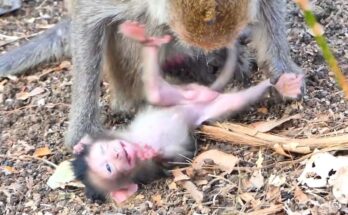
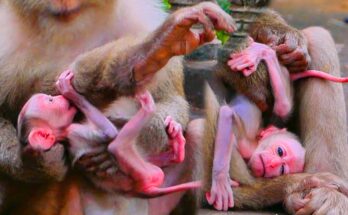
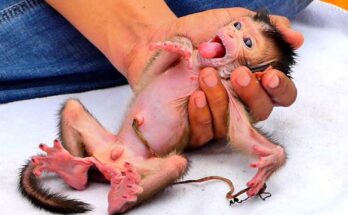
Real life daily monkeys live within complex social systems shaped by instinct, survival, and environmental pressure, and sometimes these systems produce scenes that are difficult for humans to witness. One such moment is when a mother monkey abandons her baby shortly after birth, leaving the newborn alone on the ground. While this may appear cruel through a human lens, in the natural world it is often the result of harsh conditions rather than lack of care. Monkeys live day by day, making decisions driven by instinct, health, and the demands of survival.
In monkey societies, especially among macaques and other ground-dwelling species, motherhood usually involves strong bonding. Mothers carry, protect, and nurse their infants constantly. However, not every birth results in successful care. If a mother is weak, inexperienced, injured, stressed, or lacks sufficient food, she may be unable to support a newborn. In such cases, instinct may push her to abandon the infant to preserve her own survival and future reproductive chances. This decision is not conscious or emotional in a human sense, but biological, shaped by evolution over generations.
Daily life for monkeys is demanding. They must find food, avoid predators, maintain social rank, and adapt to changing environments. Urban and semi-urban settings add extra pressure: traffic, noise, human interference, and limited natural food sources. A mother who gives birth under these conditions may already be exhausted. If the baby is born weak or the environment feels unsafe, the mother may move away with the troop. The newborn, unable to cling or follow, is left behind, crying instinctively as a call for comfort or help.
The sound of a baby monkey crying alone on the ground is powerful and unsettling. It reflects vulnerability in its purest form. In nature, crying is not only an expression of need but also a survival signal. Sometimes, another female may respond. In rare cases, an experienced or childless female may approach, investigate, or even adopt the infant. However, this does not always happen. Monkey troops are structured and cautious, and intervention is not guaranteed.
Abandonment can also occur when the mother senses danger. If predators, aggressive troop members, or human threats are nearby, staying with a vulnerable infant may increase risk for both. Leaving the baby behind may reduce attention and allow the mother to escape. These behaviors are not moral choices but instinctive responses shaped by survival pressure. Understanding this helps explain why such events occur in real life daily monkey behavior.
Human presence can unintentionally worsen these situations. Crowds gathering, people trying to touch or photograph the baby, or attempting to feed it can increase stress and prevent the mother from returning. Sometimes, the mother may be watching from a distance, waiting for a safe moment. Interference, even when driven by compassion, can disrupt natural outcomes. Wildlife experts often emphasize observation over action unless trained rescue intervention is clearly needed.
In some environments, rescue teams may step in if the baby is confirmed to be abandoned and at risk. These teams follow strict guidelines to ensure safety and minimize stress. However, not all regions have access to such support, and nature often takes its course. While this can be heartbreaking to observe, it reflects the reality of wildlife survival, where not every life can be saved.
Scenes like this remind us that real life daily monkeys do not live in a storybook world. Their lives include birth, care, loss, and difficult outcomes, all unfolding quietly alongside human society. Rather than judging these moments, they call for deeper respect and understanding. Protecting habitats, reducing disturbance, and supporting conservation efforts can help reduce the pressures that lead to abandonment.
In the end, the image of a baby monkey crying alone is not just a story of loss, but a reflection of the fragile balance wild animals face every day. It teaches humans humility and responsibility. By learning to observe without interference and by creating safer environments for wildlife, we allow nature to function as intended. The lives of monkeys, like all wild animals, deserve understanding, patience, and protection—even when their realities are difficult to witness.